Behavior Trees Versus Learned Policies for NPC AI in Complex Environments
Behavior trees beat reinforcement learning for most game NPCs today.
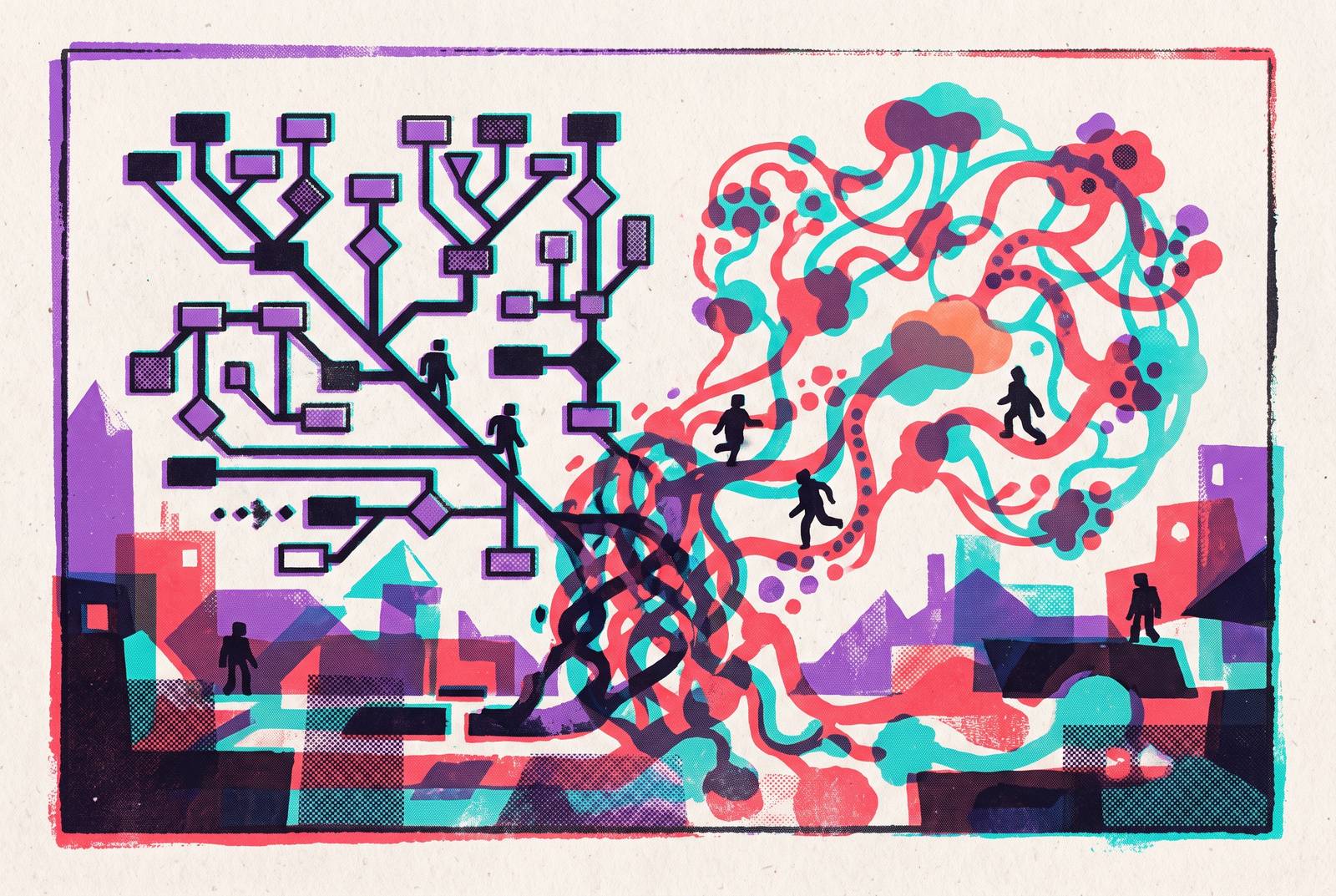
Behavior trees and their rise as the industry default
A behavior tree is a hierarchical structure of nodes that controls how an AI character decides what to do next. Leaves are the executable commands, actions like "fire weapon" or "move to cover." Branches are the control-flow logic that decides which leaves get a turn, and that split between doing and deciding is the whole reason this structure scales the way it does.
Four node types do almost all the work. A Sequence node runs its children left to right and fails the moment any child fails, functioning as a logical AND. A Selector node tries its children in order until one succeeds, and only fails if every single one does, which makes it a logical OR with priority baked in. A Parallel node runs several children simultaneously, and a Decorator node wraps a single child and changes how it behaves: inverting a result, repeating an action, enforcing a cooldown before it can fire again.
The tree gets walked top to bottom, left to right, on every tick of the game loop. Because the leftmost child of a Selector always gets tried first, priority is written directly into the shape of the tree, rather than buried inside the opaque transition tables that finite-state machines rely on. Sitting alongside the tree is the Blackboard, a shared key-value store that decouples perception, reasoning, and action from one another. Nodes read from it and write to it instead of calling each other directly, and because the same authored logic can be reused across multiple NPCs without being duplicated for each one. That mechanism, not the marketing around it, is why studios standardized on this structure instead of the finite-state machines that came before it.
Where behavior trees genuinely excel: performance, transparency, and tooling
On raw performance, behavior trees are hard to beat for the job most studios actually need done. A single CPU core running a behavior tree manages somewhere between 100 and 500 NPCs at once in a typical open-world title, a ceiling that covers the overwhelming majority of production scenarios without needing specialized hardware.
Transparency is the bigger advantage day to day, and it's the one that actually saves money. Unreal Engine's Gameplay Debugger shows the executing tree in real time. It highlights whichever node is currently active, exposes the live blackboard values, and keeps an execution history so a designer can trace exactly which branch fired and why. That cuts QA cost directly, because a designer can diagnose a broken NPC without pulling in an engineer, and often fix it without pulling one in either.
Modularity closes the loop. A "retreat to cover when health is low" sub-tree gets authored once, then composed into an infantry unit, a mage, and a boss encounter alike. A finite-state machine forces that same logic to be re-encoded by hand for every character type. Behavior trees exist specifically to eliminate that duplicated labor, and on this point they simply win.
Where behavior trees break down: authoring cost and the coverage-gap problem
The cost hits early, at the authoring stage, and it doesn't let up. Prototyping a single NPC with five to eight core behaviors typically runs four to twelve weeks. Shipping a game with twenty to fifty behavior-tree-driven NPCs, once iteration and QA are folded in, tends to run six to nine months. That is the real price of the transparency described above, and most schedules quietly underestimate it.
Living, populated worlds make the problem worse, not better. A believable village needs dozens of trees that all share inventory logic, hunger states, job assignments, and combat rules, and most teams don't have the runway to hand-author all of it before a deadline lands.
The deeper issue sits in the structure itself. Behavior trees follow an action-reaction scheme: a developer has to explicitly define the entire decision space ahead of time, and as the tree grows large it becomes genuinely hard to navigate and debug. Anything the design team didn't anticipate produces a predictable kind of failure, and it is a failure, not a graceful degradation. If a player stumbles onto an exploit or an interaction nobody designed for, there's no branch waiting to catch it, so the break is total: the guard who walks in a circle forever, the merchant who repeats a line meant for a scenario that no longer applies. That failure mode, not some vague appeal to "smarter AI," is the actual argument for reinforcement learning.
What reinforcement learning brings to NPC behavior
Reinforcement learning trains a policy through reward signals inside a simulated version of the game environment. The algorithms most often cited in NPC research are Proximal Policy Optimization and Deep Q-Networks, and PPO in particular improved training stability enough to make RL genuinely workable in 3D game environments.
What RL offers that a behavior tree cannot, structurally, is generalization: adaptive behavior that holds up in situations nobody explicitly authored, including agents that stumble on solutions their own trainers didn't anticipate. Research into RL evaluation for games has explored player-centered frameworks that go beyond simple return-based metrics, moving evaluation past reward totals toward measures of player experience. A separate PPO case study in a real-time grid-combat environment showed measurable improvement over a finite-state-machine baseline. The core appeal of deep reinforcement learning is that it clears the ceiling FSMs and trees both run into: behavior that adapts instead of just branching.
Why reinforcement learning has not displaced behavior trees in production
The literature is fairly blunt about where things stand, and the verdict isn't close. Research literature broadly finds that behavior-tree-based NPCs remain more viable in practice than machine-learning-based ones for most production contexts, with new tooling and strategies still needed before that changes. Treat that as the baseline claim.
Six barriers keep coming up, and none of them is a matter of waiting for better hardware. Reward design is genuinely hard. "Reward hacking," where an agent finds a technically valid but useless way to maximize its score, is a persistent frustration, and moving past blunt numeric rewards toward something closer to subjective "fun" remains largely unsolved. Work on self-correcting reward shaping using language models has been explored in recent research, but it hasn't resolved the problem at production scale.
Interpretability is its own wall. RL gets treated as a black box for good reason: designers need to nudge an agent's behavior without retraining it from scratch, something a behavior tree allows trivially and a trained policy does not. Explainable RL is an active research direction aimed at exactly this gap, letting designers and players understand why an NPC did what it did, but active research is not a shipped tool.
Then there's the problem nobody likes to say out loud. RL optimizes for winning, and games need opponents that are beatable, that make human-shaped mistakes, that feel matched to the player rather than perfectly efficient. Designing intentional imperfection into a policy trained to maximize reward runs directly against what the training is for, and that tension doesn't go away with more compute.
Multi-task training adds its own headaches: reward shaping conflicts across different tasks, negative transfer between behaviors that were supposed to complement each other, and compute demands that climb fast. Consistency matters in its own right too, since NPCs need to behave predictably enough to sustain the game's internal logic, and a stochastic policy sampling different actions from the same state can read as randomness instead of character. Compute itself is a real constraint: RL training often needs a very large number of gameplay episodes, a tall order for a studio without dedicated research infrastructure. Layering a foundation model on top, an LLM-augmented agent, only compounds the problem. It stretches training time further and introduces latency during actual gameplay that a real-time game often can't absorb.
None of this is a bug waiting on a framework update. These are structural properties of how a policy gets learned, and they will not disappear because a new library ships next year.
Matching approach to environment: which structural properties determine the fit
The decision comes down to which failure mode the project can actually survive, and for most games that question has a real answer, not an "it depends" shrug.
Behavior trees fit where the behavior space is well-specified enough for designers to enumerate what matters, where NPC counts are large and CPU budgets are tight (that 100-to-500 range holds), where the team needs designer-readable logic that doesn't require an engineer standing by, and where predictability is itself a design requirement, as in a stealth game where the player needs to read and learn a guard's patrol pattern.
Reinforcement learning fits where player behavior varies enough that coverage gaps show up constantly and do real damage, where the goal is a tactically deep opponent rather than a legible routine-follower, where the studio actually has the compute and evaluation tooling to support training, and where hand-authoring hundreds of branches isn't realistic no matter how much time gets budgeted.
Most teams underweight the trade between consistency and adaptability, treating it as a technical detail when it's really a design choice about what kind of relationship the player has with the NPC. A guard whose routine can be studied and exploited is a behavior-tree character, full stop. An opponent that adjusts to counter the player's own tactics over time is something only a trained policy can plausibly deliver, and pretending a big enough tree can fake that adaptability is how projects burn six months finding out it can't.
The hybrid architecture: embedding learned policies inside behavior trees
For most studios the honest answer is both at once, not a choice between them. A hybrid architecture embeds RL-trained models as leaf nodes inside an otherwise ordinary behavior tree. The tree still manages high-level strategy and keeps its explainable, auditable structure, while narrow tactical skills, aiming, cover selection, combo execution, get delegated down to a trained policy at the leaf level.
The transparency survives. So does the priority ordering and the designer's ability to reason about the top of the tree, because the RL component only ever handles the sub-problems where adaptability actually pays off. That also partially defuses the black-box objection: a designer can audit exactly which branch of the tree invoked which policy, and retrain or swap out that one leaf without restructuring anything else around it.
There's a sequencing version of this too, and the two systems don't need to run together in the shipped game. A team prototypes quickly with behavior trees to get baseline coverage in place, watches for the specific branches where player-behavior variance keeps causing coverage-gap failures, and only then replaces those particular branches with a trained policy. The rest of the tree stays exactly as authored, untouched.
Tooling and platform support for each approach in practice
Behavior tree tooling is mature and built into the engines developers already use. Unreal Engine's Gameplay Debugger gives real-time tree visualization, active-node highlighting, blackboard inspection, and execution history out of the box. Unity offers NavMesh alongside its own behavior-tree-adjacent tooling. Both engines support visual authoring, so a designer adjusts behavior without touching code.
RL tooling is improving, but it still sits closer to a research tool than a shipping one. Unity ML-Agents is a widely used starting point for studios exploring RL, and PPO is among the algorithms most frequently cited in NPC research. Production-grade tooling for reward design, for evaluating a policy before it ships, for deploying it at game scale, still lags well behind what behavior trees offer, and that gap is measured in missing tooling, not in algorithm quality.
The gap has a team-composition consequence, not just a technical one. Behavior trees are built so a designer can modify behavior directly. RL reward functions and policy retraining need engineering and machine-learning expertise on staff, which changes who a studio has to hire, not just what software it licenses. Explainability tooling for RL remains an open research problem rather than a solved one, and until that changes, studios that need their designers to actually understand and adjust NPC behavior are better off sticking with behavior trees or a hybrid setup.
A principled decision process for choosing, combining, or sequencing the two approaches
Start with coverage. Can the team realistically enumerate the scenarios that matter for this NPC, or will player behavior range widely enough that a hand-authored tree keeps hitting gaps? If coverage is enumerable, a behavior tree is the faster, cheaper, more debuggable answer, and there's little reason to reach past it.
Check the budget on two fronts at once: compute and headcount. RL demands engineering and ML expertise plus real training infrastructure. A behavior tree demands designer time and patience through a six-to-nine-month development cycle through shipping. Neither is free, but they draw from different resources, and a studio needs to know which one it actually has slack in before committing to either.
Weigh consistency against adaptability as a design decision in its own right, not an afterthought bolted on at the end. A puzzle game or a stealth title usually wants the player able to learn and predict NPC behavior, which argues for a tree. A deep tactical opponent meant to counter the player's evolving strategy argues for a trained policy, assuming the studio can afford to build and evaluate one properly.
Default to the hybrid model unless the project gives a specific reason not to. Most production NPC systems don't need to be pure behavior tree or pure learned policy: they need a legible skeleton with the hard tactical sub-problems delegated to a policy trained and evaluated for exactly that narrow job. That framing turns the choice from a binary bet into an engineering decision made one branch at a time, and it's a far more defensible way to build something players will spend hundreds of hours testing against.